
Applications
Platforms and applications that use the Embeddable Game Standard to embed, orchestrate, and distribute games.
Denshokan
Denshokan (伝承館 - "Hall of Legends") is the reference implementation of the Embeddable Game Standard. It is organized as a 6-package workspace and provides the complete stack:
- Token Contract - ERC721 with all game-components composed (settings, objectives, minter, context, renderer, enumerable)
- Game Registry - Discovers and catalogs registered games
- Viewer Contract - Efficient on-chain batch queries and filtering with 30+ query methods
- Indexer - Apibara-based event indexer writing to PostgreSQL
- REST API - Hono-based API with filtering, pagination, and WebSocket
- Client - React frontend with Cartridge Controller integration
- SDK -
@provable-games/denshokan-sdkfor frontend developers
Denshokan includes two reference games (Number Guess and Tic-Tac-Toe) that demonstrate the full game lifecycle from contract to UI.
Tip: Use Denshokan as a starting point for your own EGS deployment, or connect to the existing Denshokan instance with the SDK.
Budokan: Permissionless Tournaments
Budokan uses EGS to provide a fully permissionless tournament protocol. With EGS, games no longer need to implement their own leaderboard or revenue logic. Budokan:
- Accepts any supported token for entry fees and prizes
- Offers extensive customization for tournament formats, entry requirements, and prize structures
- Handles all leaderboard, prize, and entry logic on behalf of the game
- Mints game tokens for tournament entrants with specific settings and timing
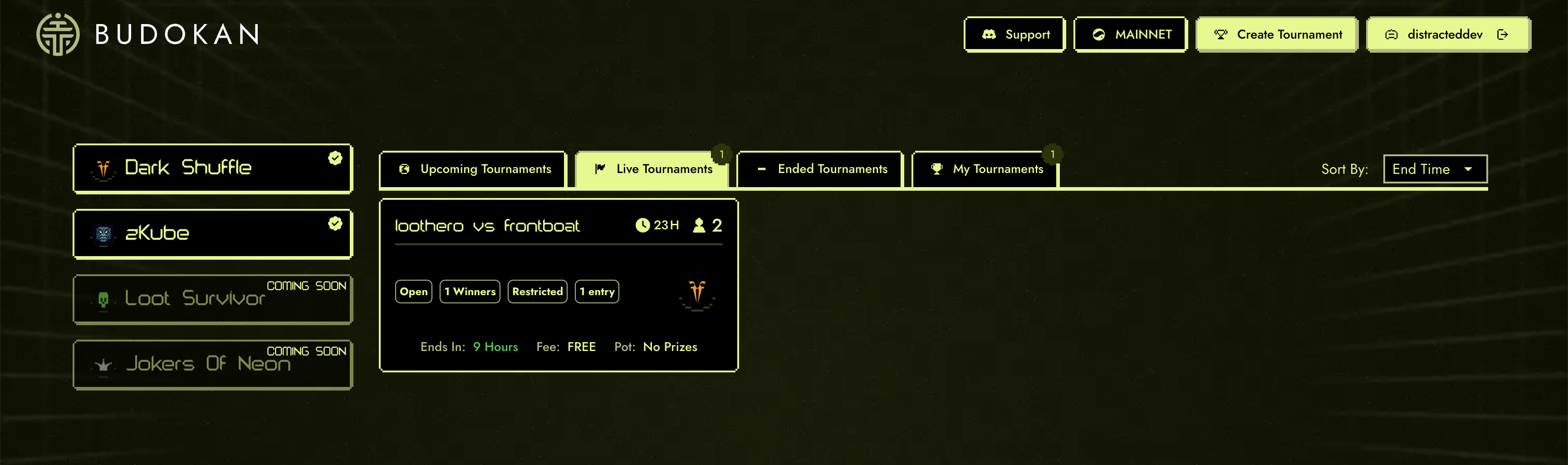 Figure 1: Budokan overview page.
Tip: By integrating with Budokan, game developers can focus on gameplay while the platform handles tournaments, rewards, and community engagement.
Eternum: Embedded Mini-Games
Eternum, a next-generation MMO, leverages EGS to embed mini-games directly into its core experience. In Season 1, Eternum introduced a quest system powered by EGS:
- Seamless integration of third-party mini-games as quests
- Emergence of new strategies and gameplay loops
- A more dynamic, deconstructed MMO experience
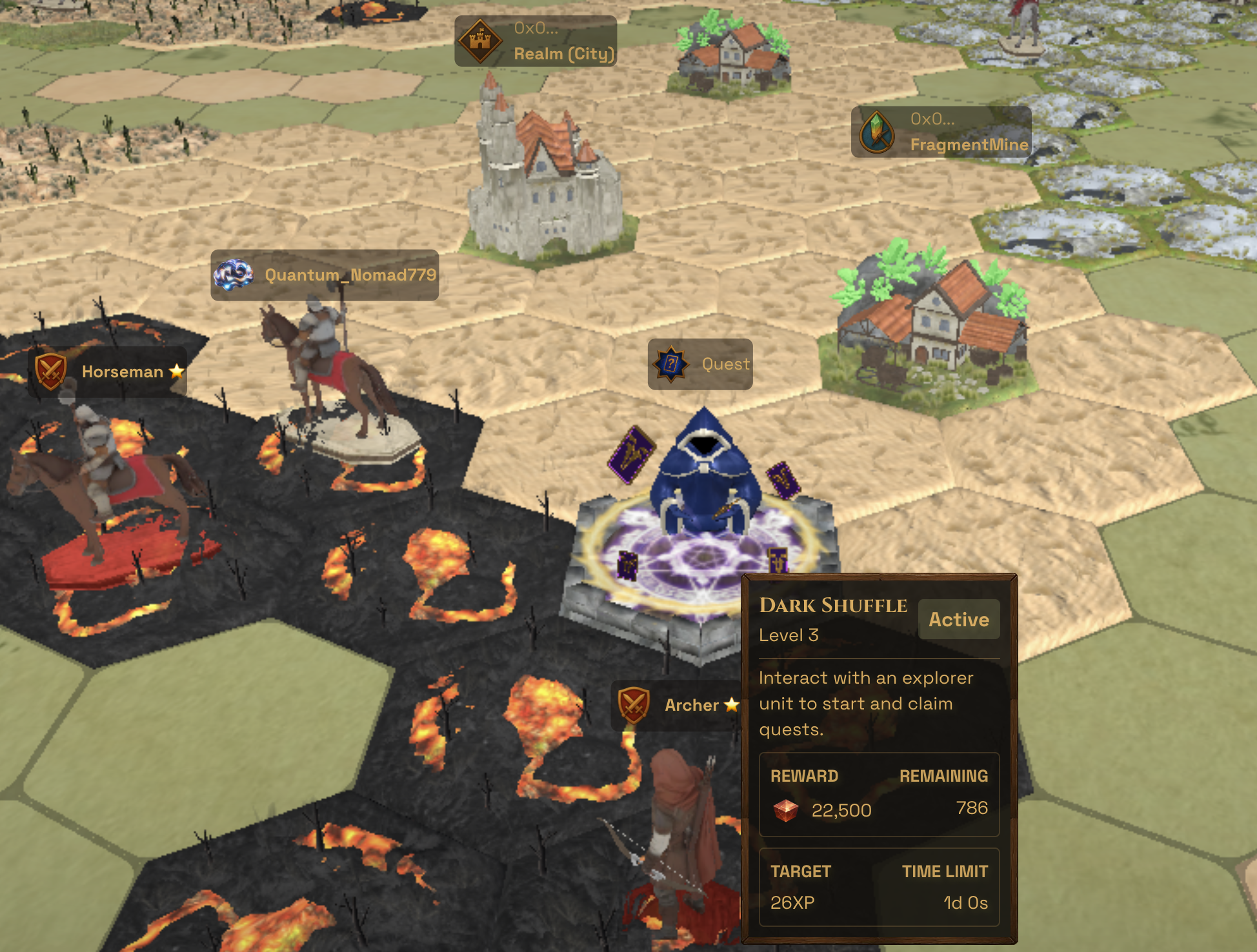 Figure 2: Eternum Quest.
Embedding games within Eternum allows mini-games to reach a much wider audience while bringing diverse gameplay experiences to Eternum's core player base.
Why Build Applications with EGS?
- Diverse game library - Instantly access every EGS-compliant game
- Easy integration - A single
mint()call starts a game;score()andgame_over()validate results - Automatic callbacks - Get notified when scores update or games complete via
IMetagameCallback - No per-game integration - The standard interface means one integration works for all games
- Royalties - Respect game creator royalties automatically via ERC-2981